FIFA’s $20 Billion World Cup Sell-Off Collapsed in Days: What It Reveals About Football Governance
PrimeSportNews | 2 November 2026
immigrationcases.org/
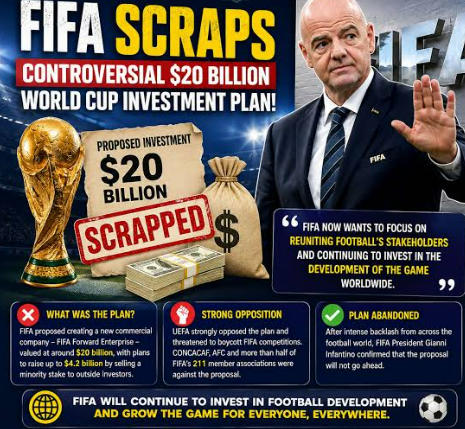
FIFA Forward Enterprise was supposed to turn the World Cup’s commercial machinery into a $20 billion business with outside investors on board. Instead, the plan lasted barely a few days. It was announced on 28 July 2026 and withdrawn on 31 July after Europe’s football confederation threatened a boycott and two other confederations refused to back it. The episode is still echoing through world football months later, from a courtroom in Manhattan to the race to lead FIFA.
This article explains what the plan was, why so many powerful voices turned against it, and what its failure says about who really holds power in global football.
What FIFA Forward Enterprise was meant to be
According to reports at the time, FIFA proposed a new subsidiary that would gather the rights and operations behind its tournaments, including broadcasting, sponsorship, ticketing and licensing, in one commercial entity. FIFA would have kept control, while outside investors would take a minority holding of about 20%. Morgan involved in the valuation. The business case rested on growth. One report put FIFA’s income from the 2026 World Cup at roughly $15 billion, up from about $7.6 billion in the previous cycle (Front Office Sports).
FIFA also dangled money in front of its 211 member associations. Accounts differ slightly on the amounts: some reports describe an increase in development funding from $8 million to $20 million per association for 2027 to 2030, plus an optional one-off $20 million payment with a 19 September deadline, which adds up to the $40 million figure that other outlets used. Approval would have needed a simple majority of members, meaning 106 votes.
Why football’s biggest bodies said no
Opposition arrived within hours and hardened quickly:
- UEFA. On 30 July, its 55 member associations voted unanimously to boycott all FIFA tournaments if the plan went ahead, accusing FIFA of putting the sport’s soul up for sale (Al Jazeera).
- CONCACAF. The North and Central American confederation rejected the proposal the same day, citing a lack of due process, though it did not threaten a boycott.
- The AFC. Asia’s confederation warned its members that the plan would fail without the support of all six regional confederations, and it declined to back it.
FIFA’s own defence was that it was only consulting. In a statement on 31 July it said it would not proceed without majority backing from its members and that, in its words, nobody was selling football. By then the arithmetic was against it: UEFA and CONCACAF alone account for 96 associations, just under half of the 211 votes, and reports estimated the president could count on only about 75 in favour.
How the FIFA Forward Enterprise plan unraveled
- 28 July: FIFA confirms the plan and sets out the numbers in a letter to member associations.
- 30 July: UEFA votes 55 to 0 for a boycott; CONCACAF and the AFC withhold support.
- 31 July: President Gianni Infantino withdraws the proposal, saying it had created divisions. Wire reports carried the news on 1 August.
- Early August: UEFA says it has lost confidence in Infantino and wants a full review of the abandoned plan (AP via Fortune, 2 August).
What the collapse reveals about football governance
This section is analysis, not reporting. The first lesson is that FIFA’s formal power and its practical power are different things. On paper, each of the 211 members has one vote and the president needs a simple majority. A unanimous boycott threat from that bloc ended the debate before any vote was held.
The second lesson is about process. Even a financially sensible proposal can fail if members feel it was drafted behind closed doors. CONCACAF’s objection was due process, not price, and FIFA itself described the plan as a consultation. Whether or not the valuation was realistic, the sequence of announcing a number first and consulting second damaged trust.
The third lesson is that the real question was never only money.
What happens next for FIFA
The fallout has not stopped. On 12 November, a federal judge in Manhattan, Jeannette Vargas, rejected FIFA’s attempt to intervene in a case aimed at blocking UEFA’s probe into the plan. UEFA’s questions centre on why Thrive Capital was given exclusive lead status among the investors.
Politically, the plan has become part of FIFA’s next election. One outlet reports that Infantino faces three challengers: Philippe Diallo of the French federation, Kozo Tashima of Japan and former Swiss defender Ramon Vega (Streamline Feed).
Key takeaways
- FIFA Forward Enterprise would have sold roughly 20% of a $20 billion World Cup commercial arm to outside investors, aiming to raise up to $4.2 billion.
- UEFA’s 55-0 boycott vote and the refusal of CONCACAF and the AFC made the plan unwinnable, and it was withdrawn on 31 July.
- The dispute has since moved to the courts and into FIFA’s March 2027 presidential election.
- The episode shows that confederations hold decisive practical power in FIFA, whatever the voting rules say.
Figures and events reflect published reports as of 19 November 2026. Details of an ongoing legal and political dispute may change.